Letting go of the chaos
People shake their heads and wonder what the world is coming to. Many wonder why things seem so chaotic and find it easy to get caught up in the turmoil they see on television, the news, the internet, and even in person.
Some want to jump into the mayhem, take a stand, prove their loyalty to whatever group, faction, belief, or cause-of-the-moment they follow. A few even change their doctrines more often than they change their underwear just to stay relevant.
Others want to avoid the melee, but worry about their personal safety, the end times, and sanity of the general population.
Personally, I’ve always advocated for the underdog, the ones without a voice, those taken for granted. At the same time, I have to understand the big picture: how does it all connect, what is at stake. I learned a long time ago to avoid jumping to conclusions and following the crowd just because everyone else is on the bandwagon.
Still, it’s easy to get overwhelmed. As an empath, I have to remind myself I am an observer. I don’t have to get emotionally involved. In fact, I shouldn’t. I don’t need that kind of chaos in my life, so I am not going to invite it in. That doesn’t mean that I don’t care. It means that I can stay level-headed.
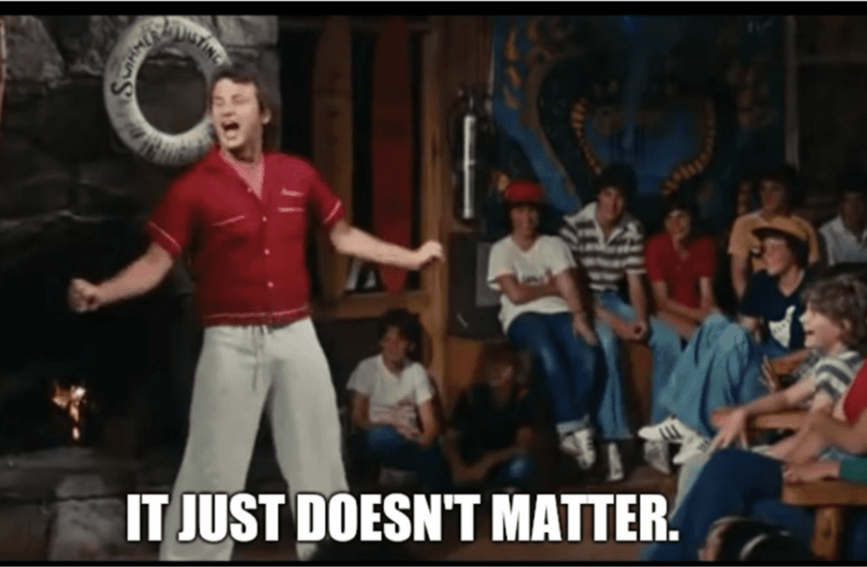
I can thank Bill Murry for the mantra, “It just doesn’t matter.” It has danced in my head for decades since I watched the original release of “Meatballs,” where he had his first starring movie role. This whacky coming-of-age story told in a summer camp setting had its hilarity, but also a moment where Bill’s character as lead counselor gives a speech to campers and counselors about their upcoming competition with a rival camp.
In the speech, he tells everyone, just because the other camp is richer, with better athletes, equipment, and cuter boys, none of it matters. “It just doesn’t matter,” he chants, with everyone else joining in.
More recently, Bashar, (an entity channeled by Daryl Anka, (I won’t go into it here, just citing the source. Go look him up.), stated, “No matter how chaotic it seems, it doesn’t matter what happens. It matters what you do with what happens.” I agree completely and have frequently said this or something similar to others. Your own behavior—actions and reactions—is more relevant to you than what anyone else does to you or around you.
In the late 1800s, Rudyard Kipling wrote, “If,” a poem which was published around 1910. (Some may recognize him quicker as the writer of “The Jungle Book.”). The poem speaks to maintaining calm during a multitude of trials and tribulations.
Crap happens. Continually. It happens in our personal lives, business lives, in our communities, our cities, states, and countries. Someone is always stirring up crap, starting crap, throwing crap, and just being crappy. Handling crap with dignity, respect for ourselves, and others is how we survive and come out sane.
Laughing at crap also helps. As I thought about “Meatballs,” I realized Bill Murray had a number of other movies with a similar theme—not the camp theme, silly. I mean the theme of recognizing what is important. Characters in many of his movies spent time discovering themselves or helping others discover themselves to ultimately find better harmony with the world.
If you need a break from the madness and time to reflect on what’s important, check one out one of these or find your own “comfort film” and turn off the outside noise for a while: