Before I got pregnant with my first child, I rarely noticed other pregnant women. As soon as I learned I was having a baby, I suddenly saw pregnant women everywhere. The same thing happened after I had the baby; there were babies popping up like weeds. The same trend has occurred with other things I have experienced or learned – I learn something new and references seemingly appear all around me. I realize the coincidence comes from my knowledge changing.
As humans, we tend to gloss over information that is not relevant to us, not in our vernacular. Children don’t pick up the adult jokes in animated films because they are, thankfully, uninformed. The jokes and references are there to entertain the adults while kids get a kick out of the general story, animation, and color.
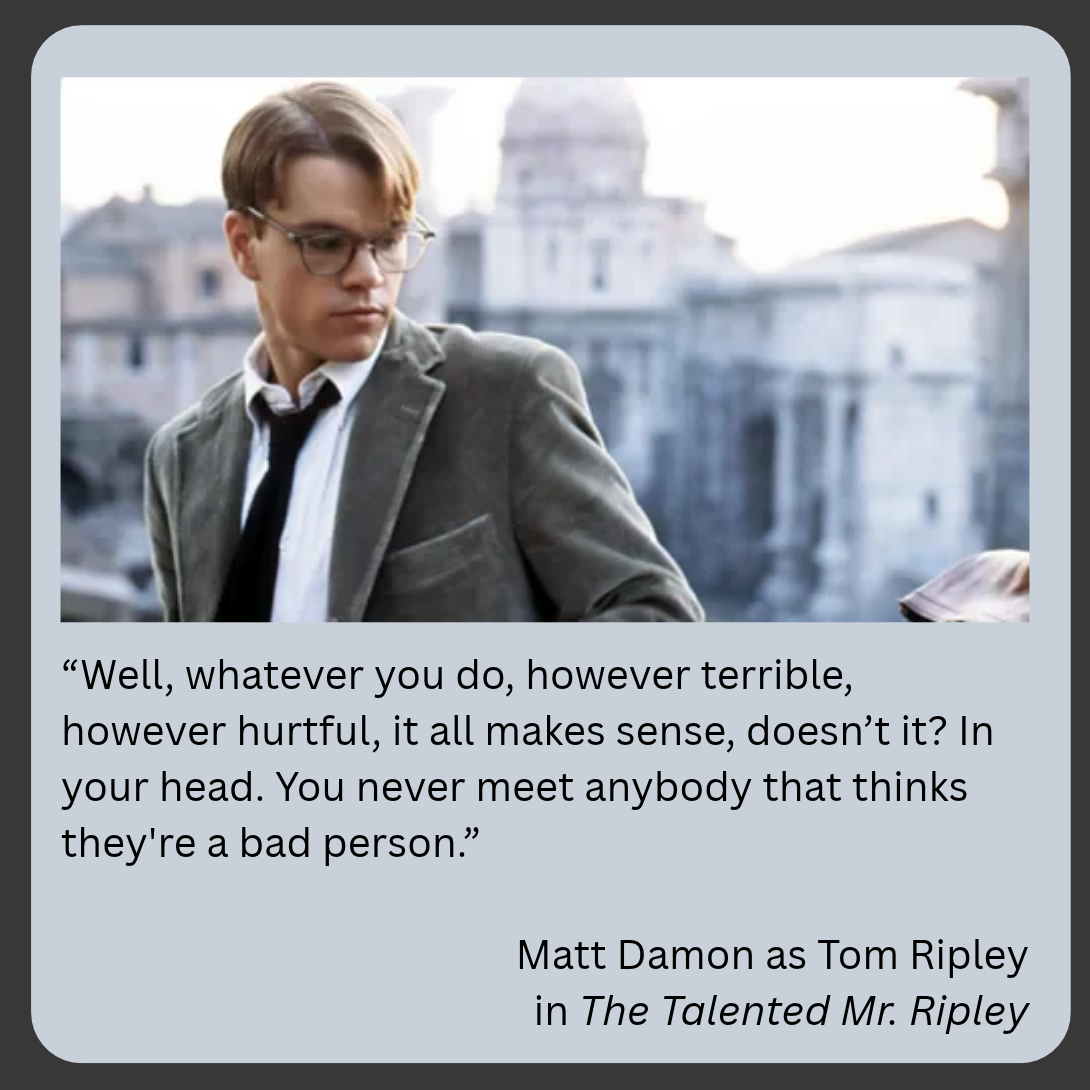
I happened to catch the movie “The Talented Mr. Ripley” (1999) on a cable station a few days ago. It’s been years since I’ve seen it and was particularly interested since I recently saw “A Talent for Murder” – a dramatization about Patricia Highsmith who wrote the Ripley books. In the film, Matt Damon, playing Tom Ripley, says, “Well, whatever you do, however terrible, however hurtful, it all makes sense, doesn’t it? In your head. You never meet anybody that thinks they're a bad person.”
At that moment, I was hearing a message that I’ve carried to others that are judgmental and angry: People, in general, are not deliberately mean. The character is essentially saying, we justify our actions to ourselves. When someone does something that could be construed as mean or hurtful, they have created a scenario – in their own head - that makes the action acceptable. When they are called out for their behavior, they often get angry because the belief they created is being challenged. Watch any protester that is challenged with counterinformation and you’ll see similar reactions.
People are also quick to judge others or jump to conclusions, self-assured their suppositions are correct. It’s easy to fit another person’s situation into the context of limited, prior knowledge. But until the bigger picture is seen, we can’t possibly know exactly what is going on with someone else. Whether you believe Jesus’ Sermon on the Mount or not, "Judge not, that ye be not judged” is valid, sound advice.
While I haven’t perfected this advice for myself, I have greatly improved my practice of it. As a result, I am taking care of me and paying attention to my feelings. If I see something on the news or social media that previously would have angered me, I am able to ask myself, “What is the whole story?” I look at how the information affects me personally, and I can recognize other people’s fallibilities as I know, I too, am far from perfect.
When I think about things people do, I wonder about the influences in their lives, what they were led to believe, and the circumstances that led them to cross my path. What can I learn from their mistakes? Everyone has a purpose, a past, and imperfections. If we each took care of ourselves, we wouldn’t judge the actions of others nor would we worry about being judged.